
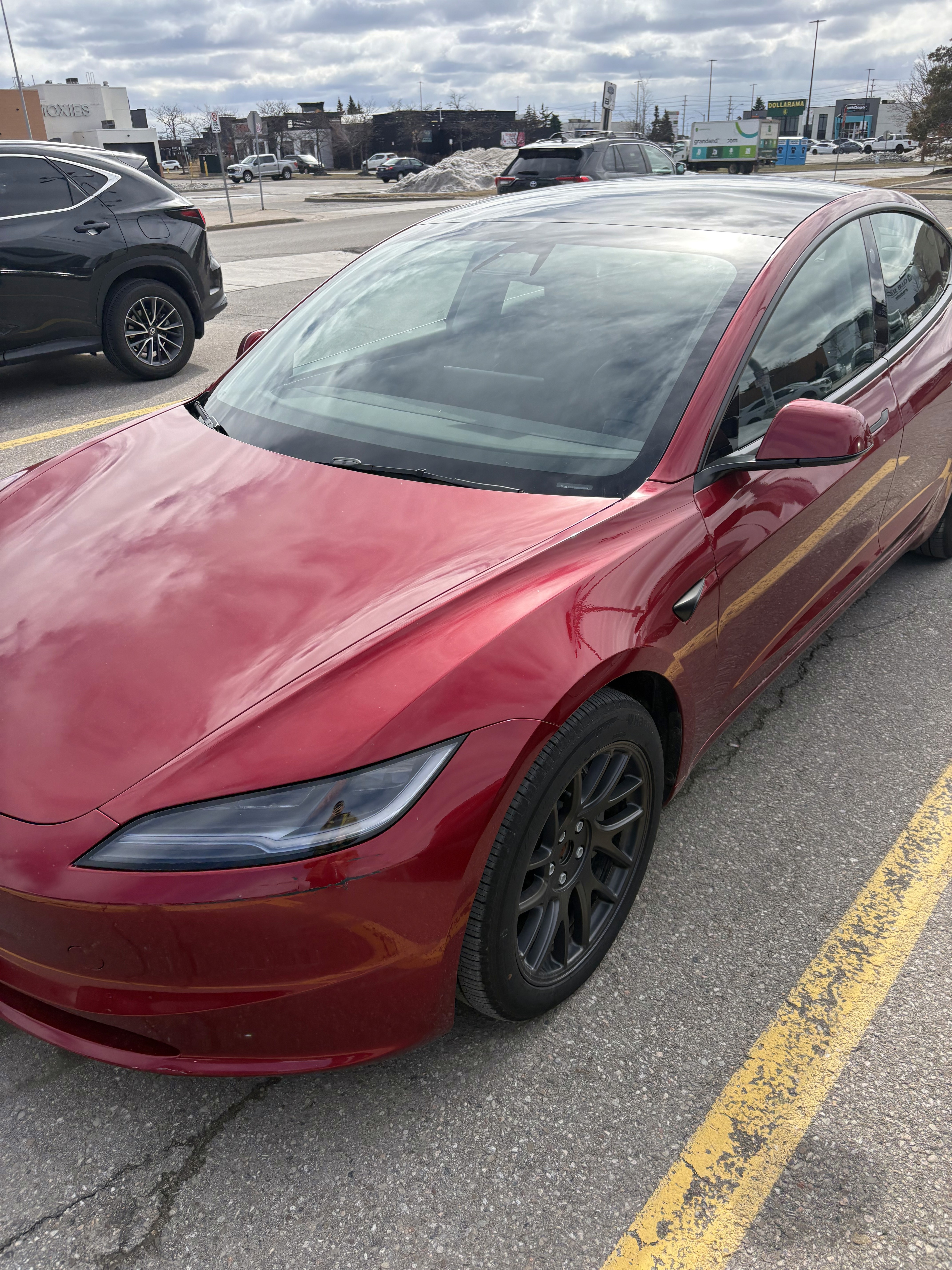
When you are window shopping or taking a rental vehicle, and you try a new brand or a different model from a familiar brand, there is usually a feeling of, “Huh, this car is different.” But not often do you feel, “Huh, this car is different, and better.” The new Tesla Model 3 is indeed such a car, even for a veteran Model Y driver.
Thanks to Tesla fixing my Model Y under warranty, I got a 2025/2026 “Highland” Model 3 loaner to test drive for a day. My first impression was that this is simply a “better” car, rather than just different.
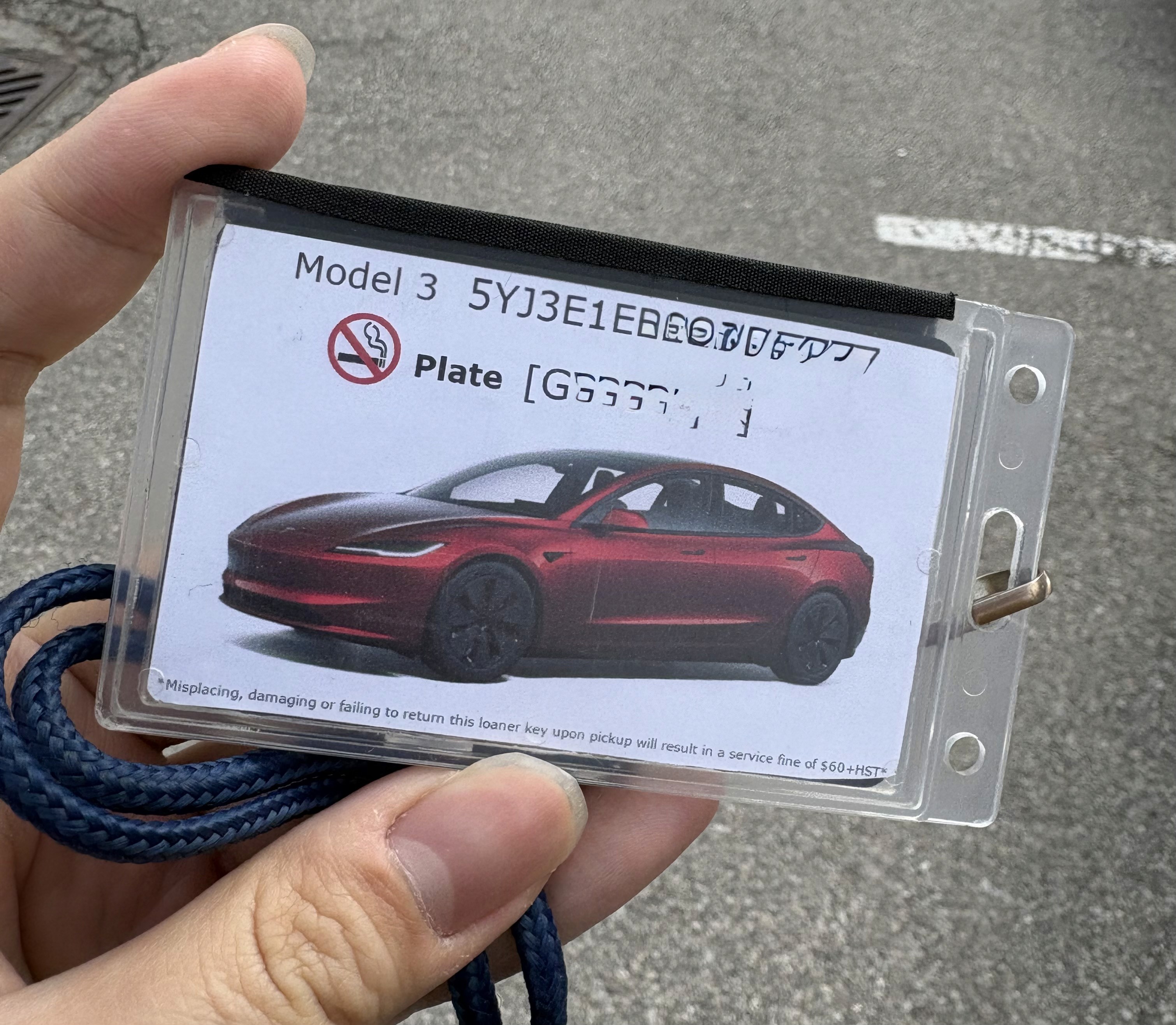
First of all, as soon as I sat in the car, the Model 3 was able to recognize all my available settings directly from my account. That includes driving settings, seat preferences, and even streaming service accounts (Apple Music and Netflix). There was almost zero transition cost for me to start driving, other than connecting my Tesla app to act as the car key so I could put away the loaner key card and its ugly lanyard.
From the appearance of the Model 3, it seems like there weren’t many changes from the previous generation of the Model 3 or Model Y, other than the refined, sharper LED lights and body lines. However, once it hits the road, everything feels different—and significantly better.
Designed for self-driving, the gear shifter has moved to the screen, with a more prominent, blue-highlighted "start self-driving" button next to it. Not to mention the simple trigger of clicking the right scroll wheel to also engage it. It yells to the driver, "This is the future, let me handle everything." As a seasoned driver myself with a bit of distrust for a new vehicle, I decided to start my first trip in “manual” mode.
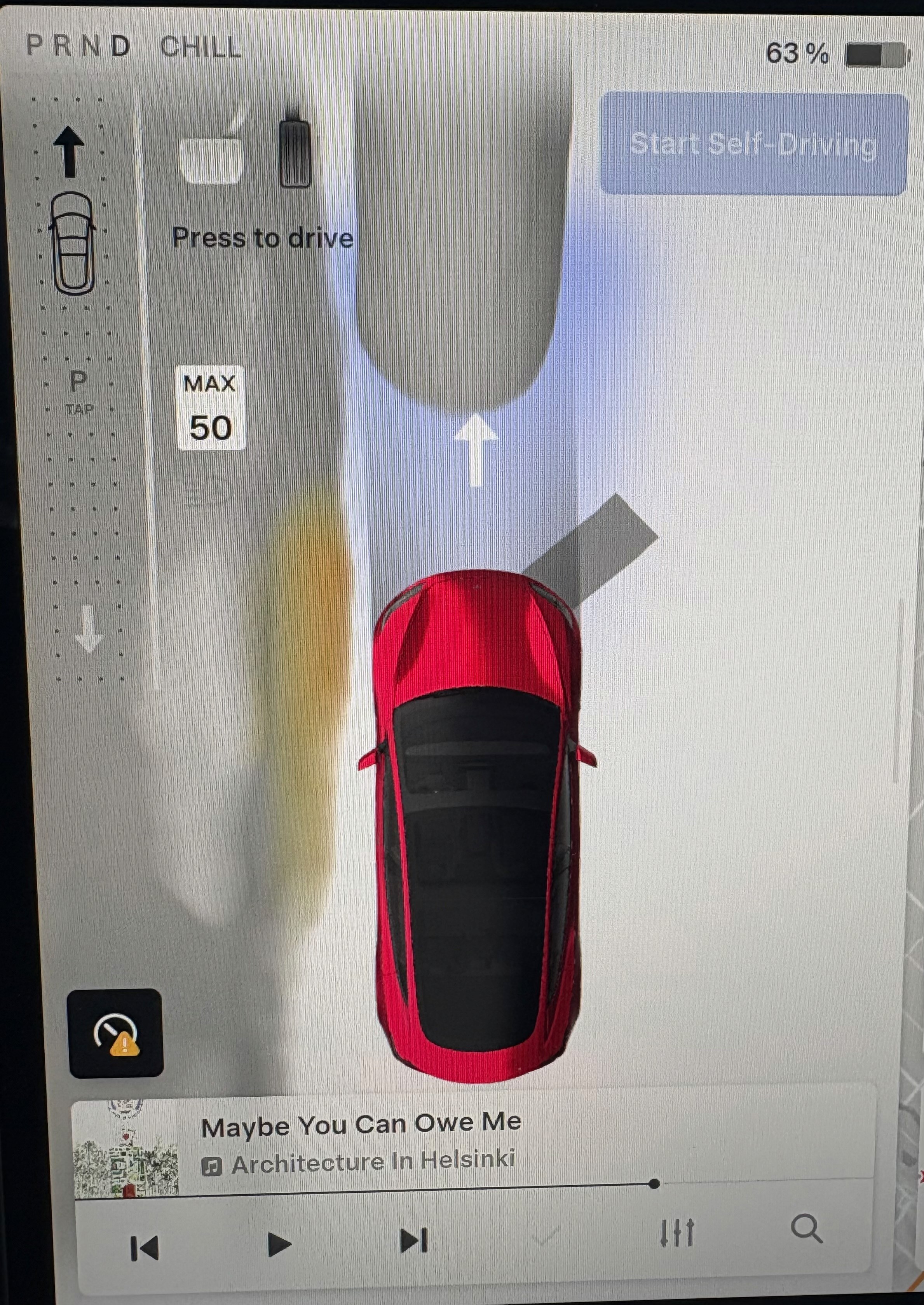
There haven’t been many changes in handling, but if I can tell anything is different, the Highland Model 3 is even more nimble, agile, and swift if you like driving yourself. The gas pedal reacts more aggressively to every push—even more so in “Standard” mode, which can make the driver feel dizzy in the way a passenger normally would, with a lot more unexpected G-force.
The ride is sportier yet more comfortable, with a softer suspension that filters out a lot of bumps, humps, and potholes on the road. If the Model Y’s stiff suspension feels like go-kart bumpiness, the new Highland Model 3 finally catches up with ICE vehicles, despite its heavy weight.
After a bit of trust-building with the car, I turned on the FSD mode. If previously I would give FSD a 90 out of 100 in confidence when I was either test driving a HW4 vehicle or driving my own HW3 vehicle, I can literally give this one a 98 out of 100 confidence level rating (FSD software version v14.2.2.5).
In my roughly 200 km drive, there was no ghost merging on the road, nor anything unexpected that made me worried for a second. As the vehicle in front of me curved a little to avoid a pothole, this Highland Model 3 followed the exact same maneuver and avoided the exact same pothole perfectly.
FSD is also upgraded with more customizations, including a Mad Max mode and more parking options. I didn’t have time to test all the parking options, but the driveway parking and parking spot auto-parking both worked perfectly. If I can be picky, it would be better if the driveway parking backed in, making it more convenient for home charging.
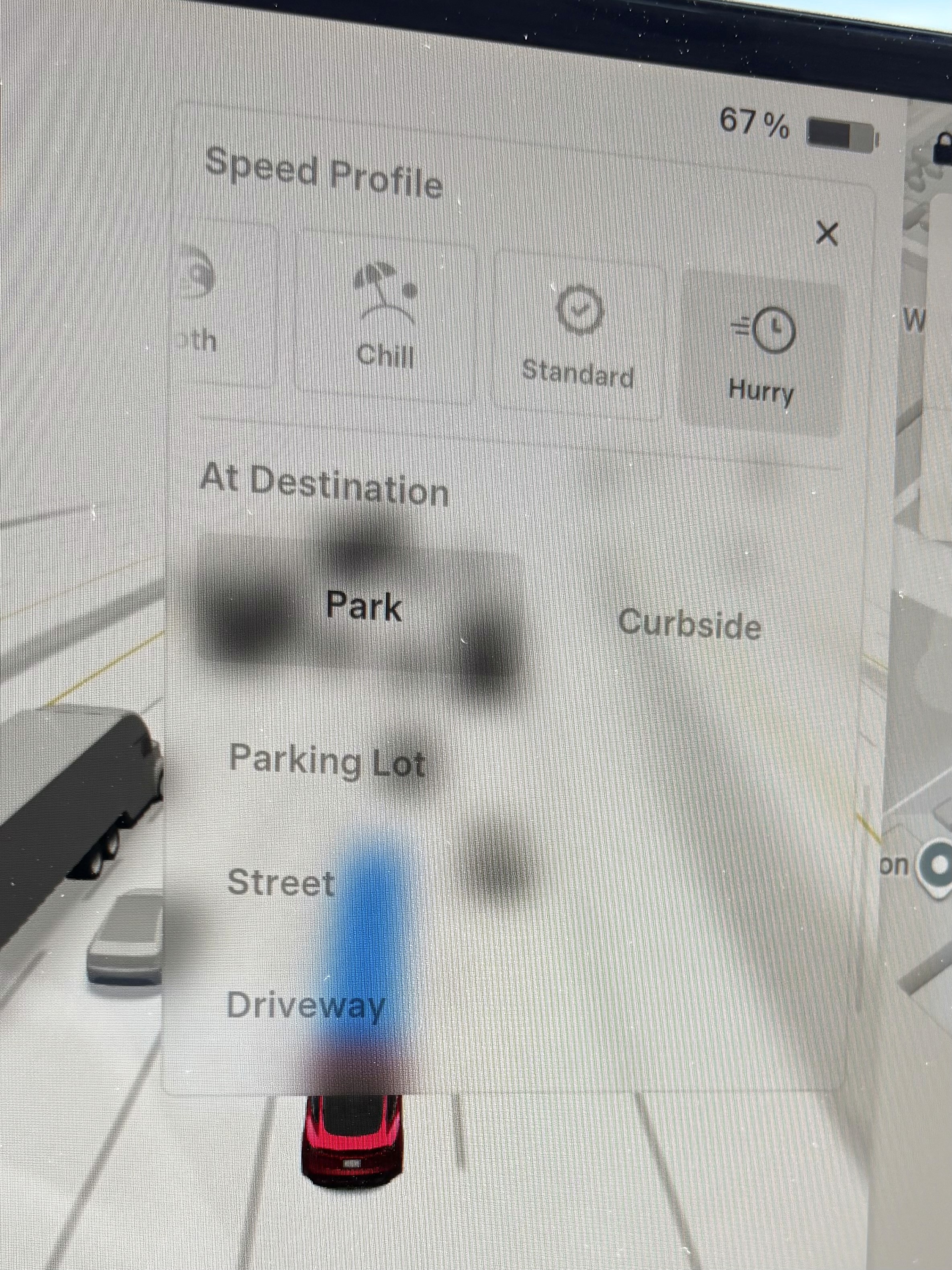
I did spend some time observing and comparing Mad Max mode while using FSD. On paper, I would expect it to make riskier moves. However, I think a clearer definition of this mode is more like: “drive as if there is no law enforcement around, but don’t risk any lives inside or outside of this car.” In Tesla’s official user manual, it’s introduced as "drives more quickly than in the Hurry profile, with more frequent lane changes," which kind of aligns with my observation.
On a road with a speed limit of 60 km/h, the speed briefly reached 85 km/h. And on a regional highway with a speed limit of 80 km/h, it briefly reached 105 km/h. Those speeds are essentially punishable by fines and demerit points under Ontario law. At the same time, I noticed the following distance is also about 20-30% closer compared to Hurry mode, which could be seen as a sort of tailgating.
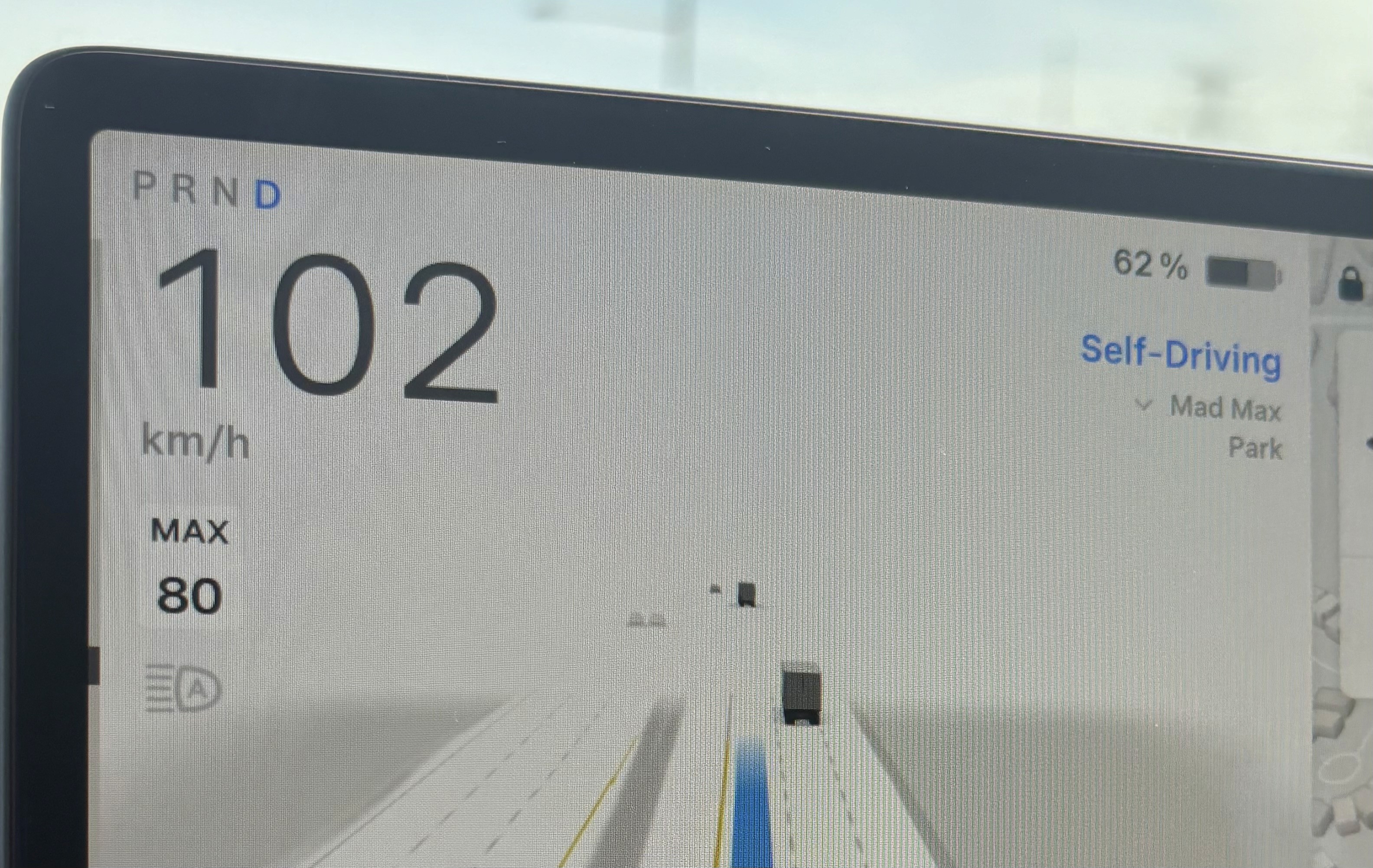
However, Mad Max doesn’t necessarily mean it will make riskier moves. It will still stop at a yellow light, and it won't move an inch until all cars have stopped at an all-way intersection. There was a time when the Tesla was waiting to turn left at a green light while yielding the right of way to oncoming vehicles. There were no vehicles coming, except one oncoming semi-truck trying to turn right, which apparently slowed down and signaled for me to take the left turn first so the driver would have room for a wide turn. The Tesla didn’t dare move even a little bit until I gave the gas pedal a push. So no, Mad Max doesn’t literally mean Mad Max—not even Super Mario Kart-style driving.
All in all, I will definitely let Tesla take charge when I don’t feel like driving the vehicle myself.
Another interesting (and also kind of annoying) change is the capacitive touch pad on the steering wheel. There are 4 light-up icons on each side, with only 3 of them having actual functions. There is one icon on each side that only indicates the function of the scroll wheel. This seemed confusing at the beginning because those icons appear to respond to clicks. Later on, I understood that the engineers designed the entire capacitive pad covering all 4 icons to be clickable. While there are no corresponding functions for the indicator icons, when reaching for them with your thumb, other areas like the left turn indicator or voice command can be accidentally triggered.
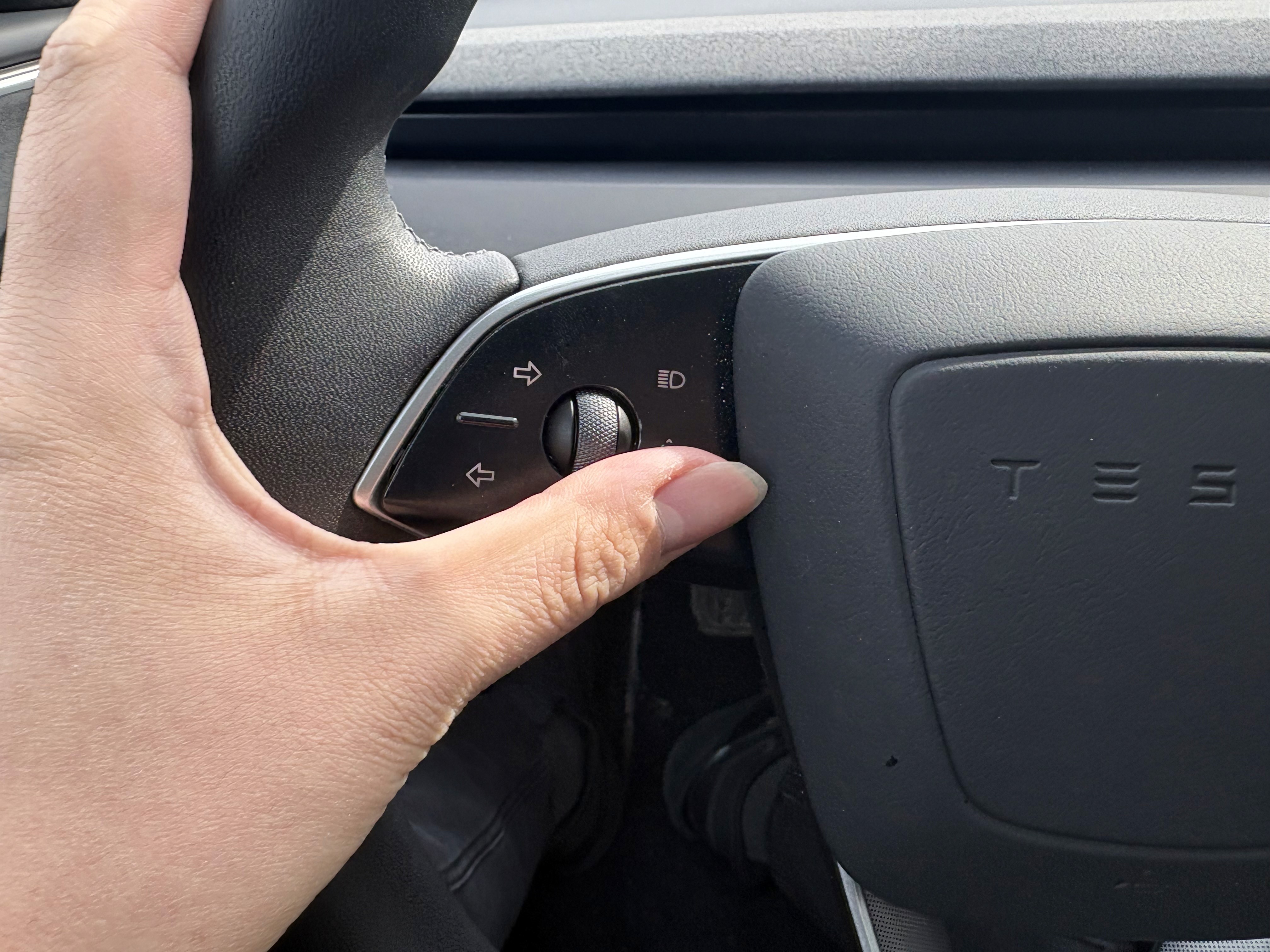
When I tried to press the diamond button (in the bottom right area of the left touch panel), it often triggered the left turn signal.
Apart from the driving experience, there are other noticeable upgrades. The surrounding RGB LED light strip definitely adds a lot of points, whether on a night drive or just hanging out in a parking lot. The wireless charger actually charges my phone instead of just overheating it all the time. A higher-resolution screen makes media streaming more enjoyable. Finally, the redesigned AC vent eliminates the possibility of objects falling inside.
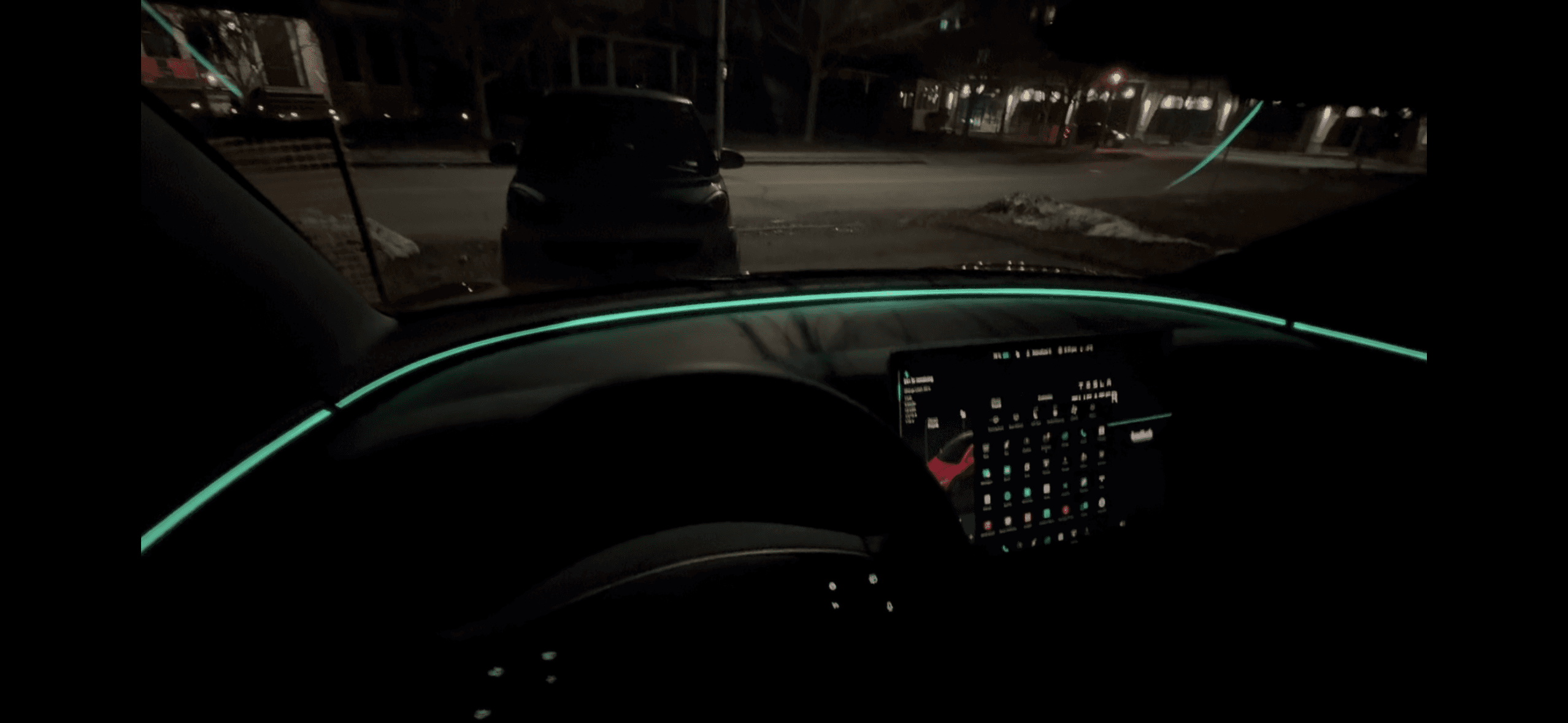
In summary, Tesla cars have evolved so much in a short 4-5 year timeframe compared to my Model Y (or even just a half-year timeframe, since I last test drove the HW4 Model 3). I don't know how much more they will improve by the next time I take the latest model out on the road. I also really don't think I will buy another ICE car, unless it's purely out of curiosity to try one out.